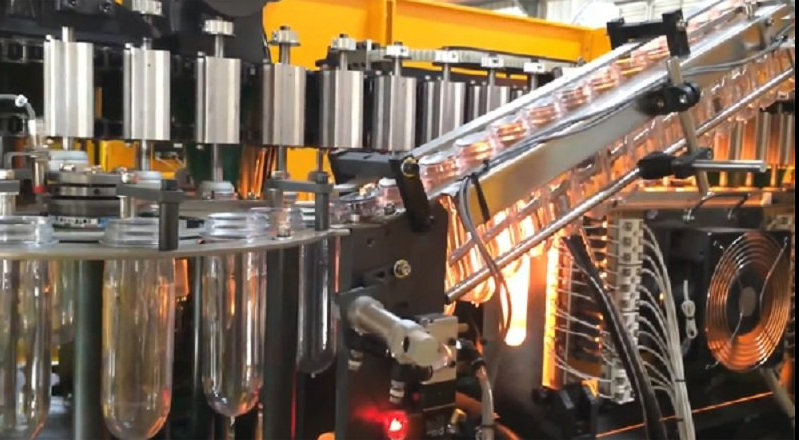
On a wide mouth jar line, the heating tunnel is where the rubber meets the road. One heater bulb that’s off its game can knock the preform surface temperature out of the narrow window you need—then you’re staring down thin walls, crystallized lips, or a blown thread finish. The machine keeps turning, but the good bottles dry up. You don’t need hype. You need a heater bulb that follows the OEM heating profile, drops in without guesswork, and keeps output steady shift after shift.
What actually matters
Wide mouth jar preforms are tricky: short neck, big open body, and a tight heating window. The neck has to stay cool enough to protect the threads, while the body has to hit stretch temperature fast. That means an infrared heater bulb built for repeatable spectral output and a stable hot zone shape. We lean on short-wave infrared halogen because it gives you fast rise time and tight control over what gets delivered to the preform surface. The quartz envelope runs hot and clean, and the filament geometry is chosen to give you a predictable heating pattern across the body—without cooking the neck. Specs aren’t wall art. They’re the difference between “it fits” and “it performs.”
- **Technology:**Short-wave infrared halogen emitter
- **Base / Connector:**R7s (double-ended), 240 mm overall length (standard fit in common heating tunnels)
- **Rated Power:**1000 W to 2000 W, matched to the blow molder’s lamp socket and control strategy
- **Voltage:**100–240 V AC, with options to match your cabinet supply
- **Spectral focus:**Output tuned for PET preform heating—fast surface response, controlled penetration
- **End-of-life behavior:**Filament designed to fail open, so you get a clear, detectable fault instead of a drifting, out-of-spec run If your line is spec’d at 1400 W, you don’t want a 1000 W bulb trying to make up the difference by running hotter than it was designed for. Temperature uniformity in the tunnel comes from matching the original heating architecture.
Why this works on wide mouth jars
Wide mouth jars don’t forgive mistakes in the heating tunnel. The body area is large, so it needs high radiant power to hit temperature quickly, while the neck and finish have to stay in a safe zone to avoid thread distortion and cap seal headaches. When the bulb underperforms, operators chase temperature by cranking up tunnel zones—and the whole profile gets thrown off. Get the wattage and spectral output right, and preform surface temperature stabilizes faster. That shows up on the floor as:
- More consistent bottle weightacross the run, because the heating profile stays put
- Fewer rejects from poor stretch behavior, because the body reaches stretch temperature without lag
- Less operator tweaking, because the tunnel doesn’t have to compensate for a weak emitter Uptime matters just as much. Infrared halogen bulbs are consumables, but they don’t have to drive unpredictable stoppages. A properly matched bulb hits target quickly, holds it, and fails clean. Fewer emergency changeouts. Fewer micro-stops. More bottles per hour. Energy use is real, too. Short-wave infrared puts heat where you need it—right on the preform surface—so you’re not heating air and then hoping the air heats the preform. That more direct energy path can cut wasted heat in the tunnel and ease the load on cooling and ventilation.
The practical details
This is a replacement component, not a redesigned system. It’s meant to drop into existing sockets and match the OEM’s thermal expectations, but your machine controls still matter.
- **Match wattage and voltage to the original.**Running a bulb at a different wattage changes the temperature profile, and the PID loop in your heating control can’t fix that.
- **Check the lamp socket and holder condition.**R7s connections are straightforward, but oxidation, cracked ceramic holders, and weak springs cause voltage drop and uneven contact. That leads to flicker, inconsistent heating, and premature failure.
- **Treat it like quartz.**Wipe with a clean, lint-free cloth and alcohol only. Oils and solvents create hot spots. Don’t touch the envelope with bare fingers.
- **Plan for warm-up.**Infrared emitters reach operating temperature quickly, but the tunnel’s equilibrium takes a few minutes. Schedule changeouts at natural stops, not mid-run, to avoid transient quality issues. If you’re running Sidel, Krones, SIPA, Husky, SACMI, or Nissei ASB blow molders, the key is staying true to the machine’s specified heating architecture. We supply the bulb with the correct connector, length, and wattage so the heating zones behave exactly as the machine expects—no retuning, no guesswork. When you need a wide mouth jar preform heater bulb that performs like the original and keeps the line stable, specify the wattage, specify the voltage, and fit the R7s. The rest comes down to consistent output, shift after shift.